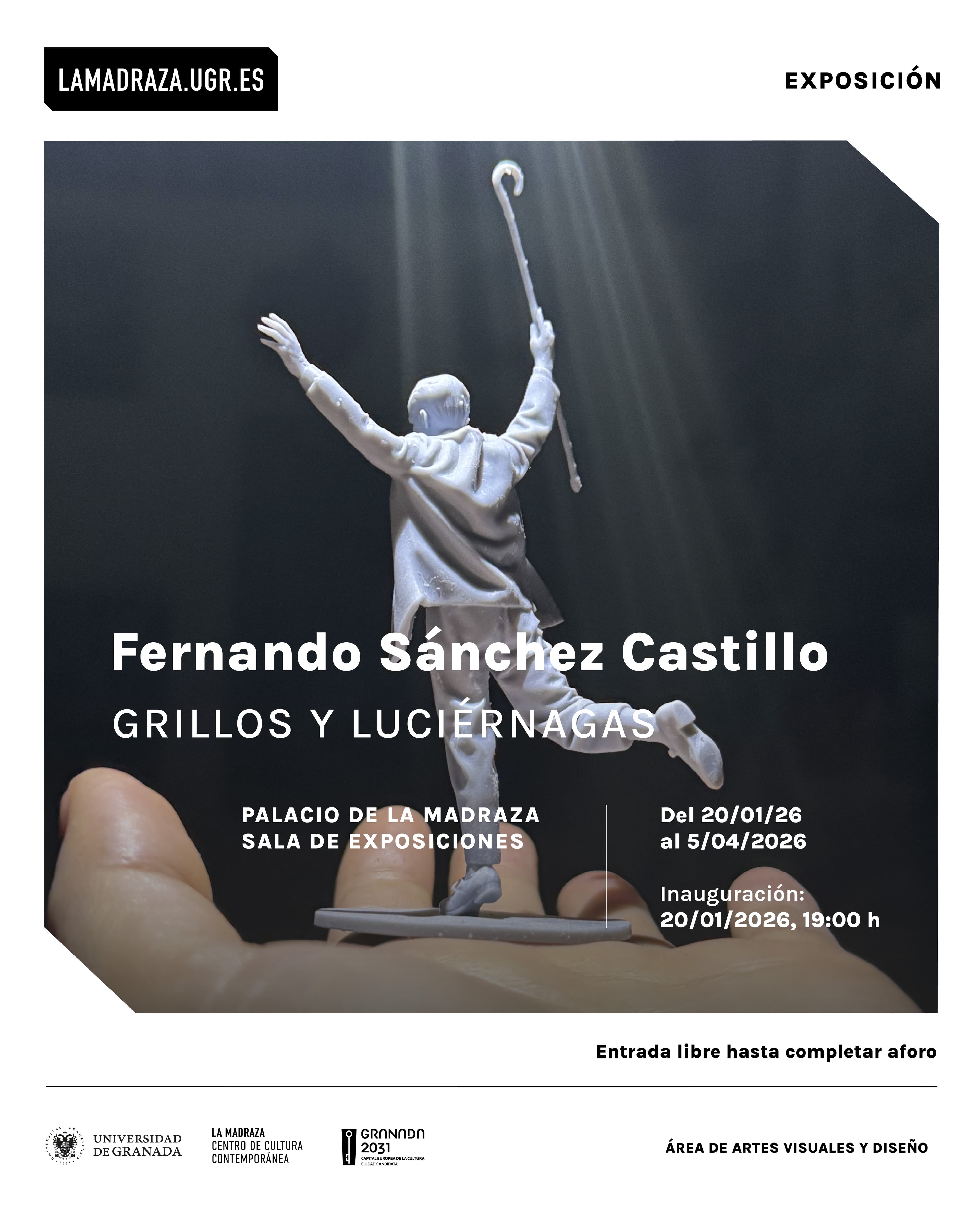
Grillos y Luciérnagas
About This Exhibition
Contemporary art exhibition by Fernando Sánchez Castillo exploring themes of confinement, exile, and historical memory through symbolism of crickets and fireflies.
Description
Crickets are those beautiful insects of the order Orthoptera that accompany us on summer nights; they are also something more disquieting, synonymous with shackles, handcuffs, chains of metallic clinking or echoes of prisoners' songs. Fireflies, besides being coleopterans, are also solitary creators, beings that shine in the darkness of time guiding our paths. Both lull us from confinements, exiles and inner exiles, illuminating us from remote and recent pasts. In America, "crickets" refers to protesters whose proclamations generate innocuous rumours to the ears of the powerful. In the Granada Vega, fireflies are the night-time asparagus harvesters who, with their caving lamps, gather the fruits of the earth by night. Velázquez's darkest painting, The Expulsion of the Moriscos, burns us with the embers of its fire in Christmas 1734. Like a ghost of Bélmez, it reappears on the walls of the Madraza telling a tale of eternal relevance. An African child is brought to this shore of the sea in the first century of our era to be enslaved; he is employed as a lamp-bearer in Augustus's palace in Hispania. His light flickers, sending us in Morse code the poem Cry to Rome, and projects onto tiny toys that could inhabit a shirt hem: a bird, a little shoe and a monkey made from olive stones, perhaps seeds from an olive tree in Víznar where the poet's body rested. All these beings, like seeds, come to life and awaken, calling to the butterflies embroidered by the 13 roses and perhaps the 12 seamstresses. They travel to Bram fleeing from the eagles, towards a sea where the Moriscos surely await them. _ Fernando Sánchez Castillo (Madrid) is a contemporary artist with solid training and research experience. His work develops a multilateral critique of monumental discourse, dismantling its agencies of power and representation. His work attempts to rewrite the narratives of history—or at least make us more aware of its complexities and traces—showing that this history is constructed from multiple positions of power. He has held solo exhibitions at CA2M (Madrid), Kunstraum Innsbruck, Sala de Arte Público Siqueiros (Mexico), Albertinum (Dresden), Stedelijk Museum 's-Hertogenbosch, OK Centrum (Linz, Austria), Kunstverein Braunschweig, Matadero (Madrid), CAC Málaga, MUSAC (León), Centre d'Art Contemporain Genève, Espai 4 and Casal Solleric (Mallorca), Wanås Foundation (Sweden), MARTa Herford (Germany) and Fundación NMAC (Cádiz), amongst others. His principal group exhibitions include Manifesta 15 (Barcelona), Diversity United in Tempelhof, Berlin, and Tretyakov Gallery (Moscow, 2021-2022), Shanghai Biennale 2018, Riga Biennial 2018, Brick a Brack at the Galleria Nazionale in Rome, Today Art Museum Beijing, Manifesta 11 (Zurich), Play at the Gothenburg Biennial 2013, Artificial Amsterdam at de Appel and Bordeaux Biennial 2009. He is currently preparing a solo exhibition at the Museo Reina Sofía for 2026. • Free entry until capacity is reached